
Business processes are becoming increasingly digitized, and companies are using a wide range of applications, tools, and cloud services. This is giving rise to a growing challenge: interface chaos. Interface management therefore plays a crucial role in modern IT landscapes. Applications, cloud platforms, and monitoring systems must communicate seamlessly with each other in order to design efficient processes and exchange data reliably. What sounds like smooth interaction in theory quickly becomes a complex hurdle in practice: the more systems are integrated, the more confusing the architecture becomes. This is exactly where the API integration platform OpenCelium comes in.

The reality of modern IT landscapes: Interfaces are growing—and becoming a source of chaos
Modern IT environments use numerous systems and applications, ranging from monitoring solutions, ticketing systems, and inventory tools to CMDBs and cloud services. Each of these applications communicates via interfaces that are often individually programmed or connected via plug-ins. However, as the number of such integrations increases, so does complexity. A small change in one system can require adjustments to many other interfaces. Different data formats and qualities further complicate matters. Information from different sources is often available in incompatible structures, which makes uniform data mapping significantly more difficult.
Without clear standards, inconsistencies arise that can spread throughout the entire IT landscape. In addition, many companies lack transparency regarding their own interface architecture. It is often unclear how many integrations actually exist, which versions are active, and where potential security gaps could arise. Without centralised management, maintenance, troubleshooting, and documentation are time-consuming and prone to errors.
The result: high costs, declining agility, and rising operating costs.

Why interface management is so important

APIs form the foundation of modern business processes. They enable automated data exchange between applications, thereby creating the basis for efficient and scalable IT structures. At the same time, the growing number of systems in use, for example in the areas of IT service management, monitoring, cloud, and security, is leading to an exponential increase in integrations.
Uncoordinated connections without standardized management pose considerable challenges. Every manually maintained interface carries the risk of transmission errors or security gaps. Changes to APIs often trigger chain reactions that affect multiple systems. The effort required for maintenance and adaptation is constantly growing.
Professional interface management ensures that companies can operate their IT landscape in a stable, secure, and efficient manner over the long term. This is precisely the approach taken by OpenCelium.

The OpenCelium API Integration Platform: Structure instead of complexity
The OpenCelium API integration platform was developed to simplify and standardize interface management and make it centrally controllable. Instead of maintaining individual scripts, OpenCelium allows all integrations to be managed via a central, graphical dashboard, with maximum transparency and minimum effort. The platform bundles all interface information in one place, displays it clearly, and allows changes or enhancements to be made with just a few clicks.


logo opencelium api hub
This transforms a confusing network of individual connections into a clearly structured, future-proof integration architecture. OpenCelium standardizes communication between systems, automates processes, and thereby reduces the workload on IT departments. At the same time, the platform improves data quality, as all transfers are traceable and consistent. Incorrect or duplicate data are a thing of the past.

The core functions of OpenCelium

One of OpenCelium’s greatest strengths is its centralized interface management. An intuitive dashboard gives administrators a constant overview of which systems are connected to each other, how many operations are currently running, where errors are occurring, and how interface versions are changing. This transparency makes it possible to quickly identify dependencies and resolve problems before they become business-critical.
Another highlight is the graphical Connection Editor, which allows interfaces to be easily created and configured using drag & drop, without any complex programming. Different data formats can be harmonized using intelligent mapping, ensuring that information is transferred correctly and consistently between source and target systems.
In addition, numerous preconfigured connectors are available for common monitoring tools, CMDB systems, ticketing solutions, and cloud applications. With the help of business templates, frequently used integration scenarios can be implemented in no time at all, without any programming required.
OpenCelium is based entirely on the open source principle. The source code is available for viewing, adjustments can be made at any time, and companies remain independent of proprietary licensing models. The platform thus offers full flexibility and long-term future security.
With version 4.4, the subscription model has also been fundamentally revised. From now on, billing will be based on the number of API operations performed each month. This means that companies only pay for what they actually use. Additional “extra ops” are available for temporary peak loads: flexible, tailored to requirements, and without changing the entire subscription.

Perfectly connected: These tools are the ideal complement to OpenCelium
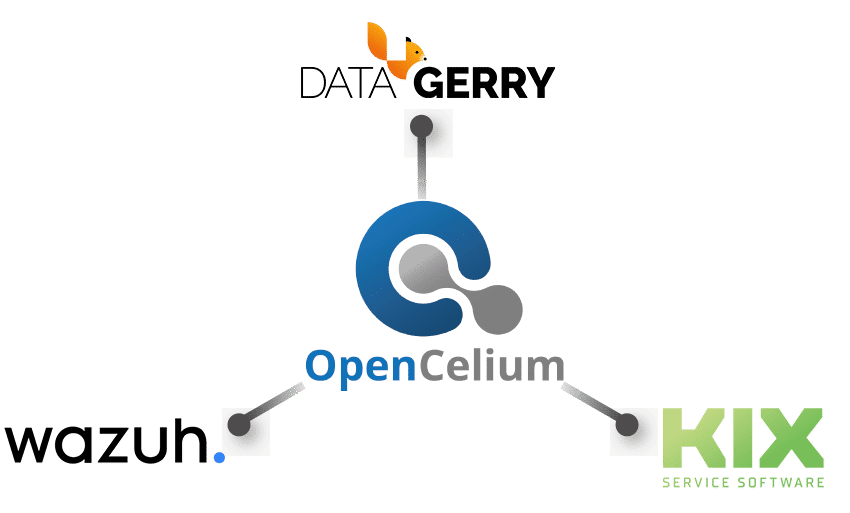
OpenCelium can be seamlessly combined with other powerful tools to make integrations even more efficient. Security solutions such as Wazuh can be directly integrated to detect threats early on and reliably protect IT systems. Ticketing systems such as KIX benefit from automated data flows that accelerate processes and reduce sources of error. With DataGerry, the entire IT system can be documented according to your own individual data model. This creates a consistent, transparent, and secure IT ecosystem that effectively prevents interface chaos and gives companies maximum control over their integrations.

The advantages of OpenCelium in daily IT operations

Future-proof scalability thanks to modular architecture
OpenCelium grows with the requirements of the company. New tools, additional systems, or increasing integration loads can be flexibly integrated without jeopardizing existing structures.
Improved compliance and auditability
With centralized management, clear logging, and traceable data flows, OpenCelium makes it easier to comply with security and compliance requirements.
Less complexity through centralized control of all integrations
OpenCelium reduces the complexity of the entire IT landscape by centrally managing all interfaces. Monitoring and status reports provide complete transparency across all active connections. Preconfigured templates and the intuitive operation of the Connection Editor significantly speed up implementations and minimize the effort required for customization.
Transparent costs thanks to usage-based subscription model
The flexible subscription model allows companies to adapt their API operations to their needs at any time. Lower maintenance costs, a reduced error rate, and clearly traceable cost structures further increase efficiency.
Faster error analysis thanks to comprehensive transparency
Logging, monitoring, and centralized status reports enable faster identification and resolution of malfunctions. This reduces downtime and provides lasting relief for support and DevOps teams.

Step by step towards a structured API landscape

In order for OpenCelium to reach its full potential, a systematic approach is recommended:

First, existing integrations should be analyzed and evaluated in terms of their relevance. Critical or frequently error-prone interfaces are given priority when transferring to OpenCelium. The next step is to define uniform standards for data formats, authentication procedures, and security guidelines. Initial integrations can then be quickly implemented using connectors and business templates. Integrated monitoring ensures that all processes are continuously monitored and can be optimized as needed. This creates a stable, scalable, and efficient API landscape step by step.

Conclusion: OpenCelium for greater order, efficiency, and transparency

Interfaces are the backbone of any modern IT landscape. However, without a clear structure, they can quickly become a stumbling block. OpenCelium provides a solution by acting as a central API integration platform that makes all connections visible, controllable, and automated.

Companies benefit from reduced complexity, greater efficiency, a clear cost structure, and long-term future security thanks to open standards. The platform offers the necessary transparency and control to not only manage APIs, but also use them strategically.

If you want to stabilize your digital infrastructure, accelerate processes, and promote innovation, OpenCelium is the ideal tool for a modern, networked, and future-proof IT world. Do you have questions, requests, or are you facing a particular challenge? Our experts will advise you individually. We look forward to hearing from you!

OpenCelium Fact Sheet

The most important information at a glance

becon blog

More articles on this topic
CONTACT
Get in touch with us!
Do you have any questions, suggestions, requests or are you facing a particular challenge? We look forward to hearing from you!